2136
/ 7
Min Read



- Tell us about your entrepreneurial and professional journey.
I’ve always been drawn to solving messy, complex problems and building something cleaner out of them. That theme runs through my career—from consulting to startups to scaling operations.
I started my career at McKinsey & Company, learning the discipline of first-principles problem-solving through strategy and transformation projects across India and South Africa. At Amazon, I saw how customer obsession drives scalable operations. Before HomeLane, I founded SkillKindle, an early marketplace for experiential learning—my first taste of building a product shaped by user behavior.
At HomeLane, I’ve been able to bring all of that together: consulting rigor, Amazon-style customer focus, and a founder’s bias for action. My vision is simple—make interiors predictable.
I studied Mathematics at St. Stephen’s College and earned an MBA from INSEAD. Outside of work, I mentor early-stage founders and stay close to operating teams—it keeps my instincts sharp and perspective grounded. I’m an operator at heart; I like putting structure to ambiguity and helping great teams compound results.
- When and how did HomeLane start? How has the experience been so far?
We began by addressing the chaos homeowners faced—unpredictable timelines, opaque pricing, and inconsistent quality. Over the years, we’ve built a full-stack system: standardized catalogs and BOMs, a unified supply chain, strict SLAs, and SpaceCraft, one of the world’s most advanced design platforms.
Today, HomeLane stands for three things—transparency, on-time delivery, and designs that fit real lives. Whether it’s Bangalore or Bhubaneswar, Delhi or Dimapur, the experience and quality are identical. Our motto remains simple: buying your home is hard enough; setting it up shouldn’t be.
- What has been HomeLane’s biggest milestone so far?
Every year has brought growth and lessons in equal measure. From launching SpaceCraft, to welcoming M.S. Dhoni as an investor and brand ambassador, we’ve had many highlights. But the biggest milestone, to me, is the predictability and quality we’ve delivered consistently for over 11 years.
Today, HomeLane completes 25–30 home installations every day, and that reliability is our proudest achievement.
- When did HomeLane start franchising, and how has that journey been?
We’ve operated on a franchise model since inception—FOCO (Franchise-Owned, Company-Operated) since 2014, and the FOFO (Franchise-Owned, Franchise-Operated) model since 2024–2025.
FOCO works well in large micromarkets—partners invest in the studio while HomeLane manages operations. FOFO empowers entrepreneurial partners to leverage our brand, tech, and SOPs to build profitable interior businesses. Both models enable rapid, disciplined expansion without compromising customer experience or unit economics.
- What is your management mantra?
Test the hypothesis, measure it, and let outcomes decide. We reward teams based on customer outcomes—that’s what truly matters. And we iterate constantly; it’s the fastest way to learn.
- How do experience centres help the brand?
Interiors are tactile—customers want to touch finishes, test lighting, and experience layouts. Our studios help them make confident decisions, especially for a home they’ll live in for the next decade or more. Paired with SpaceCraft, these studios make decision-making 10x faster.
- What are HomeLane’s top markets in India?
Our leading markets are Bangalore, Kolkata, and Hyderabad, with nearly 20 studios across them. We’re also expanding aggressively into NCR, Mumbai, and Pune.
- What are HomeLane’s expansion plans for FY26?
We plan to scale from 80 to 120 studios this year, with a strong focus on Tier-2 and Tier-3 markets. Our priority is profitable density—deepening existing cities, entering underserviced micro-markets, and maintaining high NPS.
FOFO franchising will be our primary engine for the next phase of expansion.
- Where do you see HomeLane five years from now?
We aim to become a national house of brands built on a single tech backbone. Beyond modular interiors, we’ll expand into adjacent categories and aspire to touch one in every three new urban homes in India.
- How has the home furnishings market evolved over the last five years?
Home interiors have shifted from a luxury indulgence to an accessible, productized service. Customers now expect clear pricing, faster timelines, and visual certainty before they commit.
Access has changed everything—our studios in 40+ cities let customers co-design their homes, lock scope and pricing, and track progress in real time. The category has matured from bespoke and opaque to transparent and tech-enabled, and the next wave will see this reliability reach Tier-2/3 cities.
- How will the market evolve in the next five years?
Key trends will include:
- Premiumization among upwardly mobile households in Tier-2/3 cities.
- Mass-customized modular design, with faster, factory-driven installations.
- Integrated ecosystems that combine interiors with appliances, lighting, and smart home solutions.
- Financing and assurance programs like EMIs and warranties.
- AI-driven operations for design, site checks, and project tracking.
- Supply-chain transparency and sustainable material use.
- How has technology powered HomeLane’s growth?
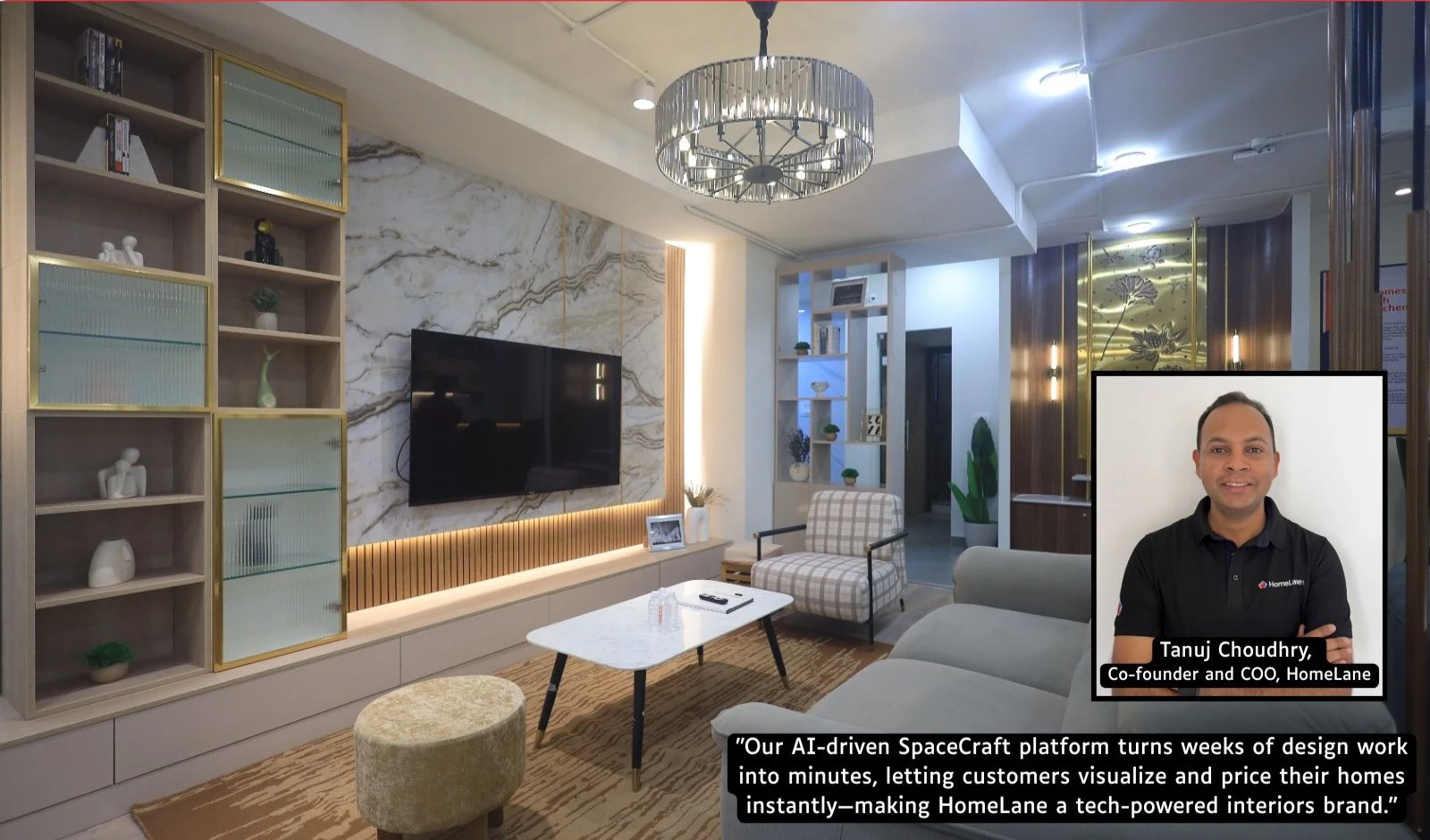
Technology is our backbone. Our AI-enabled SpaceCraft platform lets customers visualize their home in 3D and see prices update instantly as they tweak layouts or finishes.
For designers, what once took weeks now takes under 20 minutes—complete with real-time pricing, renders, and BOM integration for procurement and installation. This tech has made HomeLane a data-driven, scalable interiors brand.
- How is HomeLane catering to Tier-II and Tier-III markets?
Our mission is to make professional interiors accessible to every Indian. Through the FOFO model, we partner with local entrepreneurs who understand regional demand, while we bring tech, supply chain, and brand trust.
It’s the best of both worlds—local agility with national consistency. Franchisees know their markets; we enable them with the systems to deliver premium interiors profitably and predictably.
- What are three key trends shaping the home furnishings industry today?
- Premiumization of design choices.
- Omnichannel experiences blending digital tools with physical studios.
- Rapid organization of the market, moving from 15% to a structure resembling China’s 85% organized industry over the next decade.
- How important is franchising to your business model?
Franchising is the fastest way to combine local trust with national consistency. It’s an asset-light, scalable model where partners handle the front-end and we centralize tech, supply chain, and design IP.
It de-risks expansion, ensures quality, and creates a win-win-win for partners, customers, and HomeLane.
- How does HomeLane support its franchisees?
We provide complete support across both FOCO and FOFO models—centralized supply chain, SpaceCraft technology, transparent pricing, 45-day delivery, 10-year warranties, and marketing enablement.
From training and launch campaigns to studio operations, design assistance, and installation guidance, we ensure every franchisee runs efficiently and profitably.
- What do you look for in a franchise partner?
For FOFO, we prefer trained designers, architects, or entrepreneurs with experience in interiors or modular furniture. They should bring strong local networks and an owner-operator mindset.
For FOCO, we look for investors with multi-unit experience, strong business acumen, and the ability to manage assets in high-visibility markets. Our current onboarding focus includes Tier-2 and Tier-3 cities such as Nashik, Rajkot, Jaipur, Rourkela, and Gangtok.